Living Culture
A song for every season
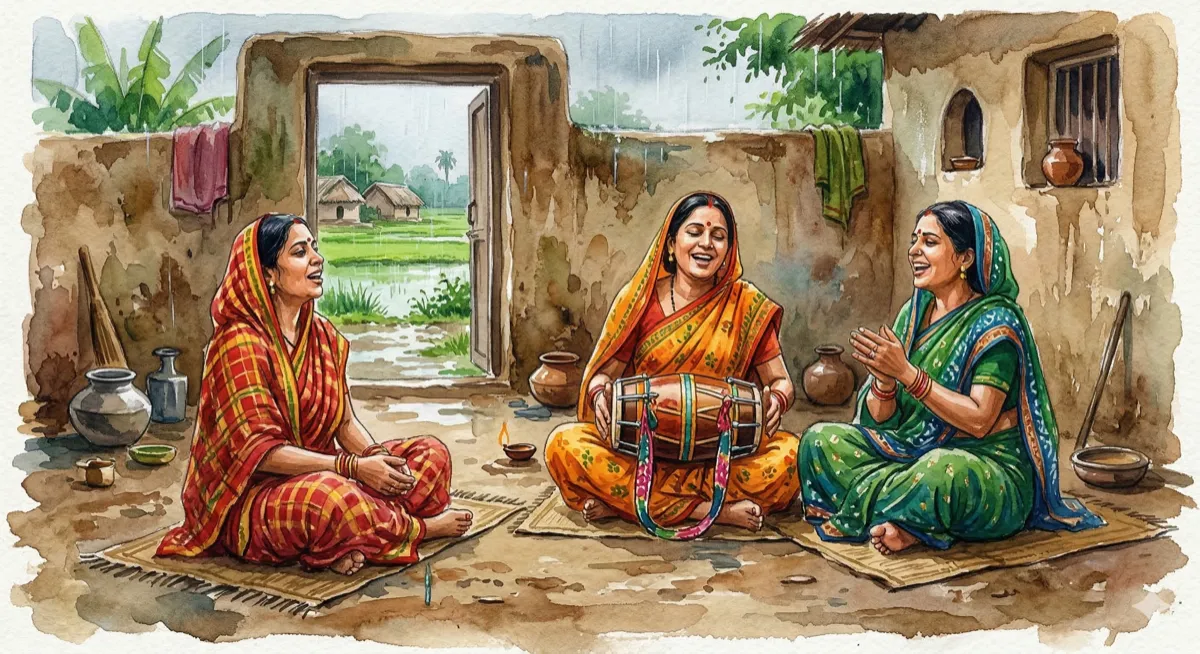
Hover over or tap a segment to explore each genre of Awadhi folk song.
Songs of Labour
When every task had its own melody
Jatsar
Grain grinding
Sung while grinding grain at the hand mill (jata/chakki). The rhythmic circular motion of the millstone synchronizes with the song's cadence.
Ropani
Paddy transplanting
Sung while transplanting paddy seedlings in flooded fields. The repetitive, back-bending labor is eased by communal singing.
Kolhui Geet
Oil pressing
Sung during oil-pressing at the kolhu (traditional oil press). The bullocks' circular path around the press sets the tempo.
Palki Geet
Palanquin bearing
Sung while carrying palanquins (palki). The rhythmic swaying of the bearers' walk shapes the melody and tempo of these songs.
Khalihan ke Geet
Threshing
Sung on the threshing floor (khalihan) during harvest season. Celebrates the culmination of agricultural labor and the promise of grain.
“The entire rhythm of agricultural life once had its own soundtrack, in Awadhi.”
The Dastarkhwan
The vocabulary of Awadhi cuisine
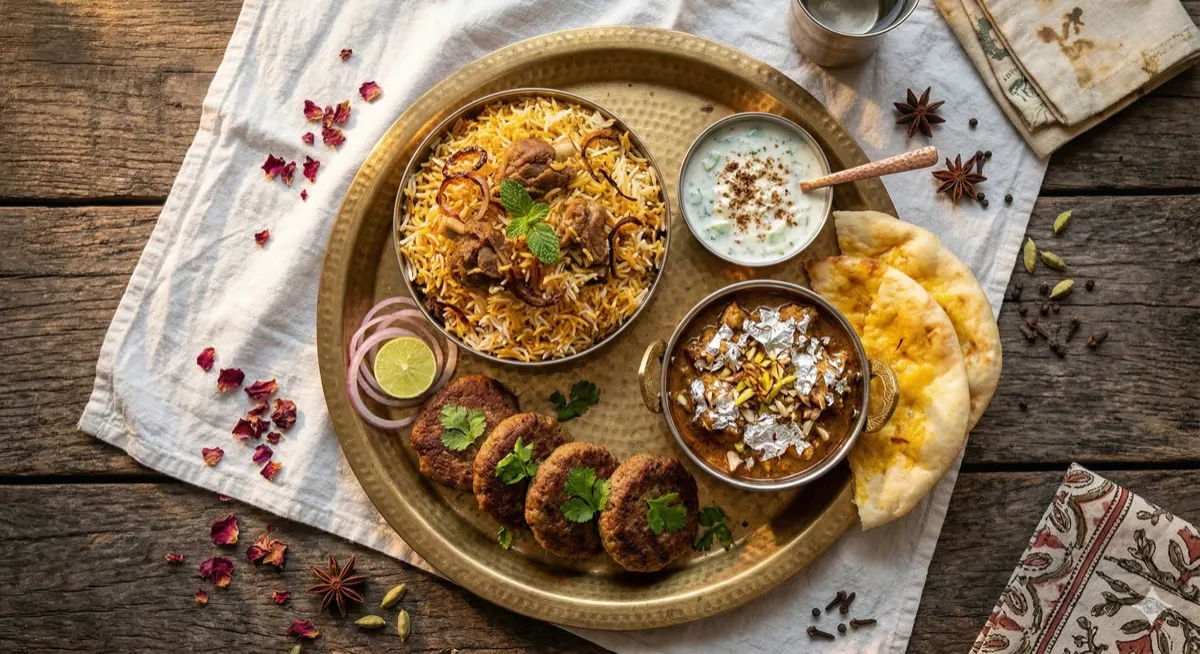
Awadhi cuisine carries a vocabulary that reveals an entire philosophy of eating.
Dum Pukht
दम पुख्त
"Breathe in + cook": slow-cooking in a sealed pot over low fire. Attributed to Nawab Asaf-ud-Daula around 1784. Ingredients sealed with dough, cooked gently in their own trapped vapors. The foundational technique of Awadhi cuisine.
Region: Lucknow
Galawat
गलावट
The art of extreme tenderization: meat that melts on the tongue. Born from the legend of a toothless Nawab who demanded kebabs he could eat without teeth. Led to the Galouti kebab with its 150+ spice blend. No English equivalent exists for this concept.
Region: Lucknow
Dhungar
धुंगर
Quick smoking technique using live charcoal and clarified butter (ghee). A finishing technique for imparting smoky flavor to dishes.
Region: Awadh
Zamin-Doz
ज़मीन-दोज़
Cooking fish or meat in a sealed pit dug into the earth. An ancient technique that predates modern ovens, using the earth itself as a slow cooker.
Region: Awadh
Mahi Tawa
माही तवा
Massive, round, flat-bottomed copper griddle used for searing fish and meats. A specialized piece of Awadhi culinary equipment.
Region: Lucknow
Sheermal
शीरमाल
Saffron-infused baked yeast bread. A signature Awadhi bread that combines the richness of saffron with the technique of tandoor baking.
Region: Lucknow
Rumali Roti
रूमाली रोटी
Bread thrown and stretched until thin as a handkerchief (rumal). The name literally means 'handkerchief bread,' a testament to the skill of Awadhi bakers.
Region: Lucknow
Bawarchi
बावर्ची
Chef, a general cook. Distinct from a Rakabdar in the Awadhi culinary hierarchy. The Awadhi kitchen distinguished between cooking and the art of cooking.
Region: Lucknow
Rakabdar
रकाबदार
Gourmet specialist, distinct from a Bawarchi. Awadhi dining culture distinguished between a cook and the artist of cooking. The Rakabdar was responsible for presentation, flavor refinement, and the art of the dastarkhwan.
Region: Lucknow

Proverbs
The worldview of Awadhi speakers
Pehle aap!
After you!
courtesyTap to reveal meaning
Jab aawe santosh dhana, sab dhana dhoori samaan
When the wealth of contentment arrives, all other wealth is like dust.
spiritualityTap to reveal meaning
Subah-e-Benares, Sham-e-Awadh, Shab-e-Malwa
Mornings of Benares, evenings of Awadh, nights of Malwa.
cultureTap to reveal meaning
Ghar ka bhedi, Lanka dhaye
The insider of the house brings down Lanka.
wisdomTap to reveal meaning
Is duniya mein teen qasai: pisu, khatmal, Brahman bhai
Three bloodsuckers: the flea, the bedbug, and the Brahmin.
social-critiqueTap to reveal meaning
Door ke dhol suhavane lagte hain
Distant drums sound pleasant.
wisdomTap to reveal meaning
Aamdani atthanni, kharcha rupaiya
Income is half-rupee, expense is full rupee.
agrarianTap to reveal meaning
Naach na jaane, aangan tedha
Can't dance, blames the crooked courtyard.
humorTap to reveal meaning
Bandar kya jaane adrak ka swaad
What does a monkey know of ginger's taste?
refinementTap to reveal meaning
Doodh ka jala chhachh bhi phoonk phoonk kar peeta hai
One burned by milk blows on buttermilk too.
wisdomTap to reveal meaning
Ab pachtaye hot kya jab chidiya chug gayi khet
What's the use of repenting when the birds have eaten the crop?
agrarianTap to reveal meaning
Boond boond se sagar bharta hai
Drop by drop, the ocean fills.
perseveranceTap to reveal meaning
Dhobi ka kutta, na ghar ka na ghat ka
The washerman's dog belongs neither at home nor at the riverbank.
socialTap to reveal meaning
Jitni chadar ho, utna pair failao
Stretch your legs only as far as your blanket.
agrarianTap to reveal meaning
Karat karat abhyas ke, jadmati hot sujan
Through continuous practice, even a dull mind becomes wise.
perseveranceTap to reveal meaning
Sukh ke sab saathi, dukh mein na koi
Everyone is companion in happiness, none in sorrow.
socialTap to reveal meaning
Chhota muh, badi baat
Small mouth, big talk.
socialTap to reveal meaning
Jaisa karoge, waisa bharoge
As you do, so shall you receive.
spiritualityTap to reveal meaning
Jekar kam ohi ka saje, aur kare to danda baje
Each task is best done by the one who knows it; if another tries, only a beating awaits.
wisdomTap to reveal meaning
“Pehle aap: in those two words lives an entire civilization's commitment to grace, patience, and putting the other person first. That is tehzeeb. And tehzeeb speaks Awadhi.”